Which dinosaurs had the longest tails?
Sauropods - long-necked, herbivorous dinosaurs that roamed around on four legs - are widely known to have been the largest land animals that have ever lived. These gentle giants thrived for some 140 million years, from the Late Triassic period until the Late Cretaceous. Even among this impressive group, however, there were some species that exceeded the rest in size, limb length, neck length and tail length. Here, we take a look at the dinosaurs that had the longest tails.
Supersaurus
Until recently, Diplodocus held the title of ‘Dinosaur with the Longest Tail’. Then scientists realised that some fossils which had been found in the 1970s all belonged to the same dinosaur - Supersaurus. The discovery meant Supersaurus was the longest ever dinosaur, at an estimated 40 metres. Around 18 metres of that is thought to have been tail, which would have measured almost two metres tall at the base and tapered to a whip-like tip.
Diplodocus
Diplodocus may now be a runner-up to Supersaurus, but its tail was still very impressive. At around 26 metres long in total, its tail accounted for about half of its body length at 13-14 metres. Like Supersaurus, Diplodocus would have used its whip-like tail for defence; one study found that the sauropod could move its tail back and forth at speeds of up to 62mph. Tail movements may also have been used as a form of communication with other dinosaurs.
Argentinosaurus
This sauropod, discovered in Argentina, was longer overall than Diplodocus, but its tail didn’t make up such a significant part of its body. Argentinosaurus’ tail is estimated to have been 14 to 15 metres long, but there is not enough fossil evidence to confirm this.
Spinosaurus
Spinosaurus belonged to a different group of dinosaurs - the theropods. These creatures usually walked on two legs, had hollow bones and primarily ate meat. While nowhere near as large as a sauropod, this dino does have the distinction of being the theropod with the longest tail. It measured 14 - 18 metres in total, with a tail that was 7-8 metres long. Like Diplodocus, its tail made up around half of its total length.
Spinosaurs was a semi-aquatic dinosaur, and its tail is thought to have been wide and paddle-like with a muscular base to help propel it through water. The tip was thinner and more flexible, helping to steer the creature as it swam.
Sinosauropteryx
This small theropod may not have had the longest tail in terms of measurement, but it did boast the longest tail relative to its body length of any theropod. Sinosauropteryx’s tail made up over half of its total body length, containing 64 vertebrae (almost double the amount in a human spine). Fossil evidence suggests it was a pretty tail too, with a stripe pattern that helped it to hide among the plants of the Early Cretaceous period.
Discover Dinosaur World Live
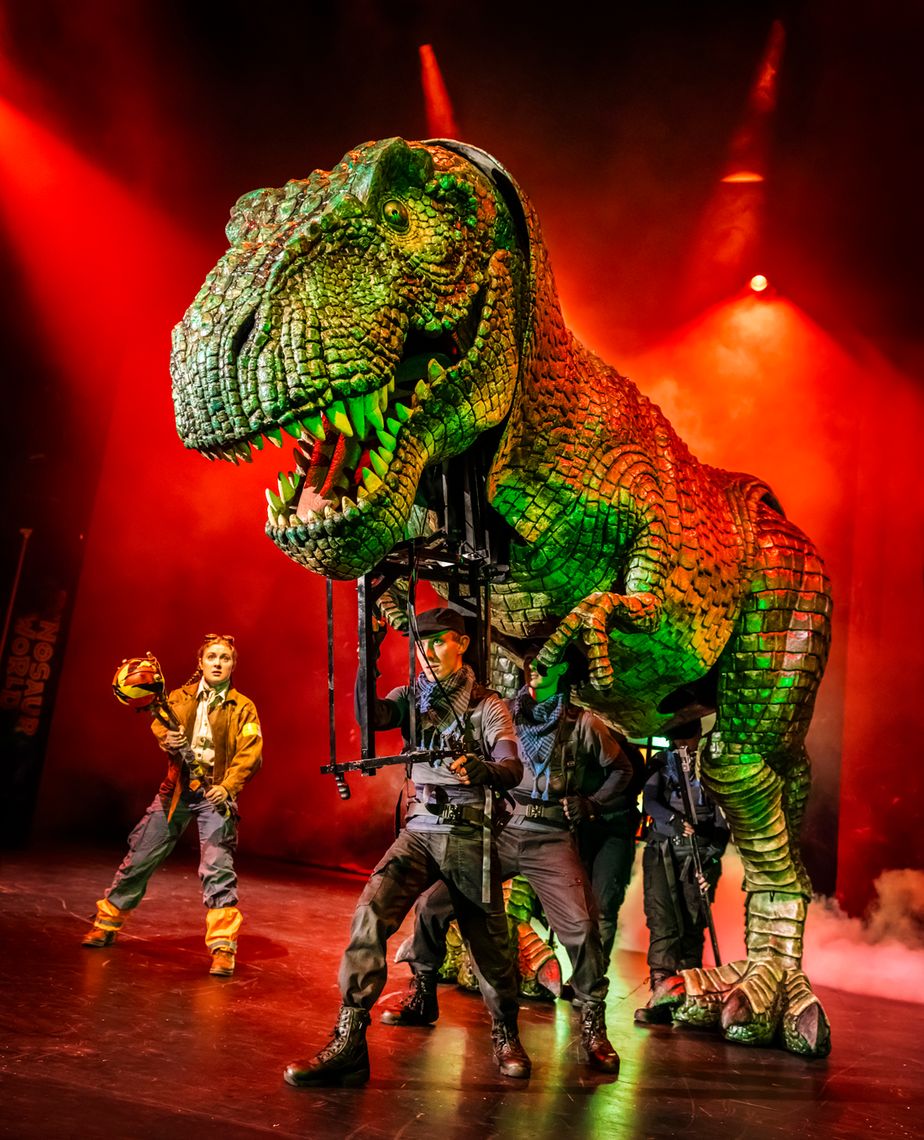
Join a prehistoric adventure with Dinosaur World Live, a dinosaur family show that introduces you to some of the most fascinating creatures of the Mesozoic era. Aimed at kids aged three and up, it tells the tale of gentle giants and tiny terrors using stunning puppetry. Search ‘dinosaur event near me’ to find out if your local venue is on the UK tour, and book your dinosaur tickets today.